News ·
DSHS Response Roundup – Week of June 22, 2026 New World screwworm (NWS) Current situation There have been no confirmed human cases of NWS in Texas. DSHS is ready to respond to human cases, should any occur. As of June 22, 2026, there have b
DSHS Response Roundup – Week of June 22, 2026
New World screwworm (NWS)
Current situation
- There have been no confirmed human cases of NWS in Texas. DSHS is ready to respond to human cases, should any occur.
- As of June 22, 2026, there have been 15 total confirmed animal cases in Texas: three cows in Zavala County (one inactive), two cows in La Salle County, a goat in Gillespie County, four cows and one goat in Edwards County, one sheep in Crockett County, one sheep in Sutton County (now inactive), one goat in Terrill County and one cow in Tom Green County.
- DSHS is prioritizing the safety of the food supply and assisting partner agencies in protecting Texas livestock and wildlife.
Key messages
- The food supply in Texas is safe.
- Texas has a strong meat safety system. Every animal that enters the food supply is inspected by state or federal inspectors before and after slaughter. Those standard inspection practices would identify any wounds infested with NWS.
- Anyone who regularly interacts with animals should routinely inspect them for wounds and any sign of NWS infestation. And they should know how to report suspected cases.
- People who work around livestock, and people who sleep outdoors are at greatest risk for NWS. They should take precautions by keeping wounds clean and covered and using insect repellent.
Key DSHS activities
- DSHS hosted two webinars for clinicians last week. Register to view the recording.
- Zoonosis Control Branch is a second virtual training for animal control officers Tuesday (today) at 10-11:30 a.m. Link: https://register.gotowebinar.com/register/3260029342757190752
- DSHS is hosting a session on Thursday at 12-1:30 p.m. for local health departments to begin preparing for possible human cases. Link: https://teams.microsoft.com/meet/280431134105955?p=zTp74LcpWck41MYHCi
- DSHS has resources to educate people how to prevent, identify and report NWS cases. Find them at the bottom of the DSHS New World Screwworm page. Spanish materials are also available on the DSHS website.
- Meat safety and dairy programs have distributed materials on NWS detection and reporting to licensed operations.
- Regional veterinarians have been presenting information to city and county elected officials in and around affected areas.
- DSHS and federal partners continue to inspect all animals entering the food supply. DSHS is increasing the frequency of inspections of operations that process animals directly for consumers.
Reporting suspected cases
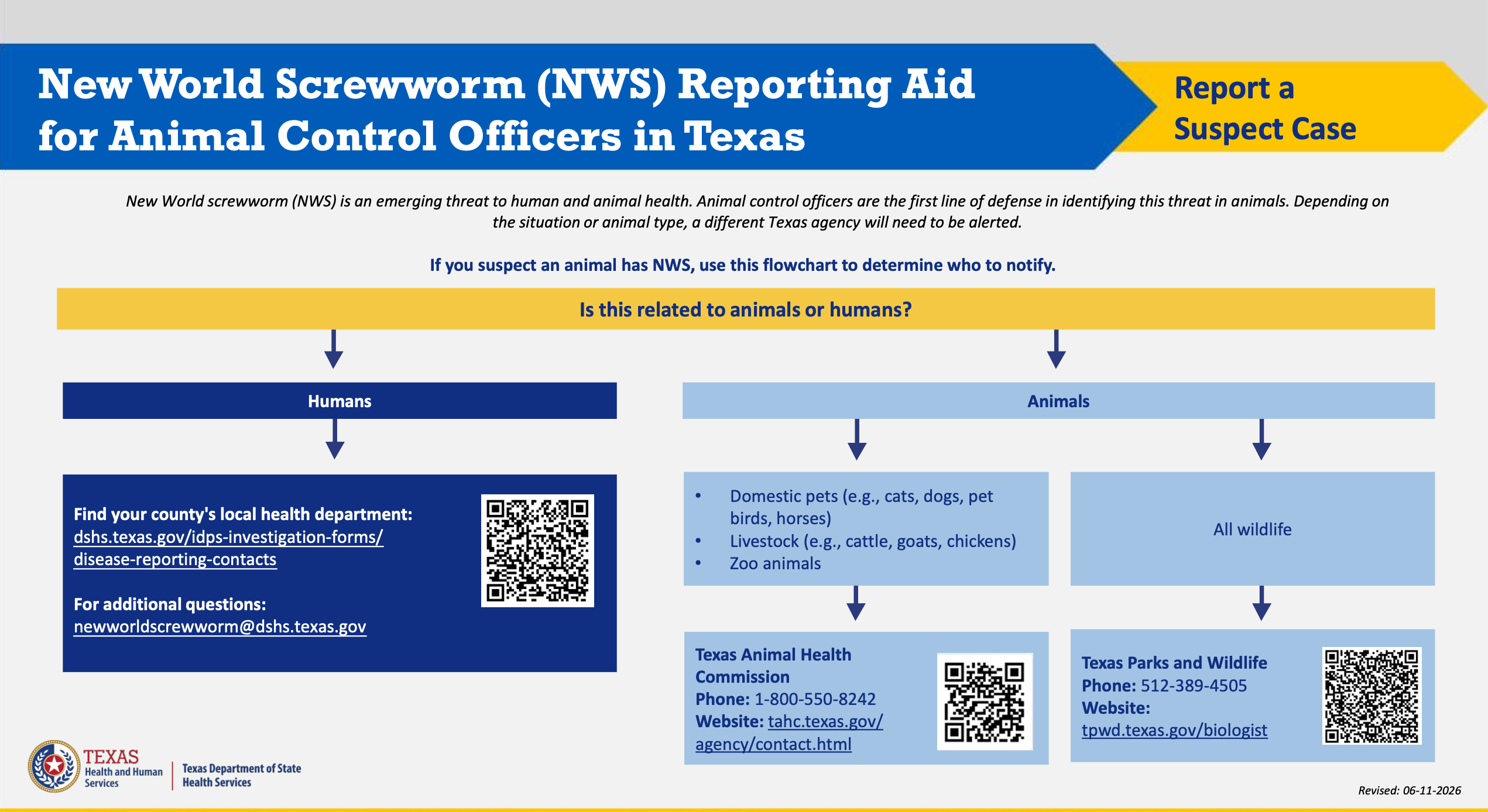
- Livestock and exotic animals: Texas Animal Health Commission regional office or 800-550-8242
- Wildlife: Texas Parks & Wildlife Department local wildlife biologist
- Pets and other companion animals: Individuals should take their pet to their veterinarian. Vets should contact the TAHC regional office or 800-550-8242.
- Humans: People should seek medical care. Clinicians should contact the local health department or DSHS regional zoonosis control.
DSHS resources
- New World Screwworm (NWS) | Texas DSHS
- Spanish: Gusano barrenador del Nuevo Mundo (NWS) | Texas DSHS
- Human Sample Submission: DSHS Lab Submission Guidance
Other resources
- Current situation: Texas Animal Health Commission (TAHC)
- NWS zone maps (TAHC): Interactive Map of NWS Zones
- Animal sample collection and submission guidance (TAHC): EMGuide_NWS-CollectionGuidance_Form538.pdf
- Wildlife information and reporting (Texas Parks & Wildlife): New World Screwworm - Diseases - Wildlife
- Pet case identification and treatment (Texas A&M AgriLife Extension): Companion Animal Care in the Face of the New World Screwworm (NWS) Threat
Graphics and informational flyers:
-----------------------------------------------------------------------------------------------------------------------------
ORIGINAL POST
The New World Screwworm has been in the news lately, with confirmed detections of the insect in five Texas counties, according to the USDA.
The parasitic fly that feeds on the tissues of warm-blooded animals is a serious pest of livestock and wildlife. It has NOT yet been reported in Caldwell County as of this evening (6/12).
Early detection is key. Watch for unusual wounds that do not heal, wounds containing visible larvae (maggots), or signs of infection in livestock and pets.
INFORMATIONAL PAMPHLETS
REPORT SUSPECTED CASES
- Reporting suspected human cases or human health concerns in Public Health Region 7: (254) 778-6744
- Reporting suspected NWS in pets and livestock to Texas Animal Health Commission: 1-800-550-8242
- Reporting suspected NWS in wildlife to Texas Parks and Wildlife Department: (512) 389-4505
DECLARATION OF DISASTER
A state of disaster has been declared for Caldwell County due to the imminent threat posed by the New World Screwworm.
Declarations of disaster are issued to unlock emergency funding, activate mutual aid, and grant local leaders special legal powers to manage threats. Without an official declaration, a local government cannot easily access higher-level resources.
USEFUL LINKS FOR INFORMATION AND TRACKING CASES